

Fast & Safe Hornet Nest Removal Across Devon & Cornwall
Hornet Nest Removel Devon & Cornwall
Hornets are larger, more aggressive, and more dangerous than wasps. Their stings can be extremely painful, and disturbing a hornet nest can lead to multiple stings within seconds. Dartmoor Pest Control provides fast, safe and professional hornet nest removal across Devon, Cornwall and Dartmoor, with trained technicians equipped to handle high-risk situations quickly and safely.
Have you a nest ?
Your attention will be drawn to insects with yellow, black & Orange markings flying in and
out of a hole or opening. The hornet enter and exit with great accuracy. Should you be compelled to
check out where they're nesting, you'll typically see a paper ball hanging from a rafter or a raised area.
The nest will range in size from a golf ball to a basketball, depending on the time of year. If you discover
a nest any time between December and March, you are safe to remove it as it's dead and empty.
Removing old nests is unnecessary because they cannot be reused by hornets in the future.
We remove nests whenever possible.
In the case of an attic, the best practice is to check it out to see if the nest can be accessed, with a view to removal. hornets nests can be treated with chemicals from the outside and left in place but you will be left with dying hornets crawling around the attic floor with the potential of half dead wasps dropping down through holes in the ceiling, eg. through downlighters, the attic hatch or gaps around pipes. The nest you believe to be dead has three weeks more to live. new wasps will continue to hatch and you may be left wondering why you keep finding half dead hornets n the house. Removal is the best policy.
Another reason for inspecting the attic.
is that in the the event of the nest being near your water storage tank, you may have had wasps straying into the water and drowning, with the result that rotting hornets bodies foul the water supply. We have found that the greater majority of tanks are left open and uncovered. This is the water in which you bathe and brush your teeth.
The standard professional hornet nest treatment.
An increasingly common solution for killing hornets nests is to apply an insecticidal dust to the hornet entry/exit point with the use of a dust stick. The entry is most often a small hole in your fascia. A dust stick is a long lance which allows the operator to apply the chemicals from a distance.We do not use dust sticks. We find it better to inject the chemicals directly into the hole or cavity that the hornet are using, this ensures a better treatment.
Unfortunately, hornet nests located in flat roofs,
attic corners and under floor areas cannot normally be removed. These nests, by their location, are out of reach and in any case dying wasps are unlikely to pose a problem. You could of course take the option of leaving them alone and wait untill November by which time they'll have completed their life cycle. You can then seal up the hole that attracted the attention of your queen wasp 7 months earlier.Remember, wasps are beneficial insects and can be left in peace if the location of the nest is out of the way and you're quite sure they're not bothering anyone.

🐝 Hornet Nest Entry Point in lofts and attics
This image clearly illustrates a common Nest point for a hornet nest: a structural of extension.
The hornets are using this loft as a highway to their chosen nesting site, which is likely
situated within a close proximity, generally less than a meter from the entry crack.
A loft space structure in poor repair, such as the one pictured, presents an open invitation
to hibernating queen Hornet in the early spring. They actively search for secure, sheltered,
and readily accessible voids—perfect conditions offered by damaged roof spaces, fascia boards,
or poorly sealed soffits. Once a queen establishes her nest, the colony will rapidly grow throughout the summer.
The most effective strategy for preventing wasps from nesting in your property is exclusion:
-
Proactive Proofing: Conduct regular inspections of your home's exterior, particularly roof lines, eaves, and window frames. Any visible crack, gap, or hole, even a small one, should be sealed using exterior sealant, mortar, or mesh appropriate for the material.
-
Remove the Invitation: By meticulously eliminating potential entry points, you remove the initial attraction for a searching queen. No Holes, No Wasps remains the simplest and most effective preventative pest control measure against these unwelcome summer tenants.
Dealing with a nest in a confined structural space like this is difficult and potentially dangerous; professional treatment is highly recommended to safely eliminate the colony and ensure the nest is completely sterilised.

🐝 Advanced Tracking (For Distant hornets Nests or Asian Hornets)
Observe the Flight Path
-
Identify the Line: Find an area where hornets are frequently flying. Wait patiently and watch a few workers.
-
Follow the Line: Hornets are very direct when flying back to the nest; they don't wander. Note the exact direction one flies after leaving a food source or landing near your property.
-
Find the Hole: Follow that direction. The flight path will converge on a single, discreet entry/exit hole. This hole is your target.
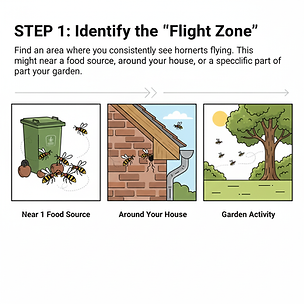


Pick an individual hornet and observe its flight. Hornets fly in a very direct, straight line when heading to or from their nest. Visualize this straight path.
Hornets prefer to nest in dark, sheltered cavities, usually 2 meters (6 feet) or more above the ground (except for some ground-nesting common wasps, which are sometimes mistaken for hornets)
🛑 What to Do When You Find the Hornets Nests or (Asian Hornets)
Once you find the nest entrance:
-
DO NOT approach or disturb the entrance. Disturbing the nest will provoke the entire colony, leading to mass attacks.
-
DO NOT attempt to block the hole. This forces the hornets to chew a new exit, which could be into the interior of your house.
-
Immediately call a Dartmoor pest control. They have the training and specialized, powerful insecticidal dust to eliminate the nest safely and effecti
Unlike most other wasps, the European hornet is facultatively nocturnal, meaning it is active during the day and will also fly at night, especially on warm evenings.
Here is a breakdown of why they gather around lights:
1. Indirect Attraction: The Hunting Ground Theory
This is the most widely accepted reason: the hornet is not necessarily drawn to the light itself, but rather to the abundance of prey that the light attracts.
-
Prey Hub: Artificial outdoor lights (especially bright white or blue lights) act like beacons for
-
countless other nocturnal insects, such as moths, beetles, and flies.
-
Easy Dinner: Hornets are efficient predators. A porch light creates a high-density,
-
captive food source for the hornets. They view the light as a reliable, convenient hunting
-
ground.
2. Navigation Confusion
Like many insects, hornets use natural light sources—the moon and the stars—to help them
navigate.
They fly by keeping the natural light source at a constant angle to their bodies, which allows them to
fly in a straight line.
False Horizon: A nearby artificial light source (like a street lamp or window light) overwhelms
these natural celestial cues.
Disrupted Path: Because the light source is close, trying to maintain a constant angle to it causes
the hornet to spiral inward, leading them to fly erratically around the light source and even repeatedly tamp
against windows trying to reach the light.


🍯 DIY Queen Hornet (Asian) Trap (Early Spring)
🛠️ Materials Needed
-
1 or 2-Litre Plastic Bottle (clear soda or water bottle).
-
Sharp Knife or Scissors.
-
Bait Mixture (see section below).
-
String or Wire (for hanging).
➡️ Instructions
-
Cut the Bottle: Use the knife or scissors to cut the top third of the bottle off. Cut just below where the top section begins to taper.
-
Invert the Top: Remove the bottle cap. Flip the cut-off top section upside down and insert it into the bottom section of the bottle, like a funnel.
-
Seal the Funnel: Tape the edges where the two pieces meet securely. The hornets will crawl into the wide opening but struggle to find the small neck to escape.
-
Add the Bait: Pour the specialized spring bait mixture (see below) into the bottom of the trap, ensuring it doesn't touch the neck of the inverted funnel (you don't want the hornets crawling out on the liquid).
-
Hang the Trap: Use string or wire to hang the trap from a tree branch, post, or near a sheltered area where queens might be looking to nest. Place it in early spring (April/May).
🍎 The Crucial Part: Selective Spring Bait
In early spring, queen hornets need sugar for energy to start building their nests, but they also need protein to feed their first batch of larvae. This specific need allows you to use a more selective bait to avoid catching beneficial honeybees and butterflies.
SeasonHornet Food NeedSelective Bait Mixture
Early Spring (April/May)Sugar AND Protein1 cup water + 1 cup sugar + 1 shot of vinegar + a small piece of meat (like tuna, ham, or raw fish).
Late Summer (Aug/Sept)Sugar OnlySweet drinks, fruit juice, or beer
Why this bait works in Spring:
-
Sugar & Water: Attracts the queen for energy.
-
Protein: Provides the necessary attractant for the queen to collect food for her first workers.
-
Vinegar: The vinegar discourages honeybees from entering the trap, as they do not like the strong acidic smell.
❗ Important Notes for Trapping
-
Timing is Key: Trapping is most effective in April and May, when the queens are actively foraging alone. Trapping later in the year mostly catches sterile workers, which does not significantly impact the total number of colonies.
-
Empty Frequently: Check the traps every few days and empty them. You can use this time to refresh the bait and remove any non-target insects.
-
Placement: Place traps in sheltered, sunny areas, preferably near wooded edges, sheds, or outbuildings where queens emerge from hibernation.

Why Choose Dartmoor Pest Control?
-
Fast and safe hornet nest removal
-
Experienced technicians trained in high-risk insect control
-
Fully insured and licensed
-
Local family-run business
-
Same-day response available
-
Competitive pricing with no hidden fees
-
Discreet, unmarked vehicles
