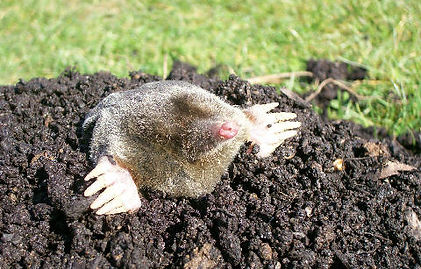
Mole control Devon & Cornwall
Mole Removel Trapping Devon & Cornwall
We provide a fast reliable service for the removal of Moles
We promote a totally organic and poison free way of catching moles, all we use is a trapping system. We have found this to be the most effective way of catching moles No payment is sought until the mole is produced. This honest way of country life
OUR SERVICES:
1. We carefully inspect the area for active mole tunnels, we then carefully place our traps, covering each for the safety of children & pets.
2. We service the traps and monitor the entire area for activity at least three times a week.
3. When all activity has stopped, we remove the equipment & provide the customer with an invoice.
GUARANTEE:
Should another mole move in to your property within two weeks, we will waive the inspection & set up fees, charge only our per mole trapping fee.
Although one mole has been caught, customers
need to be aware that once a run is vacated by
a mole, another mole can move into that set of
tunnels offering a ready supply of food.
Re-infestation therefore can & frequently does
occur no matter which treatment method is used.
DIY mole control does not work, the mole moves out or blocks the runs for a while, continues to make new runs elsewhere, then moves back when the DIY has settled down.
By DIY'ing you could actually make things worse. Moth balls, windmills, vibrating probes upturned bottles, pouring foul smelling and sometimes dangerous substances down the mole hills won't work. The mole will block the run affected and just go round the obstacle.
Sometimes when I get called to a mole control job some of the above incidents have occurred, and people have been cheated by so called professionals or the DIY has not made any difference. Please call a expert as soon as you have a mole problem.
Devon & Cornwall Mole Control Contract
We offer a reliable and discreet mole control service across Devon & Cornwall, tailored for both small and large outdoor spaces.
-
Contract includes treatment for up to 3 active molehills
-
Free call-out included – no hidden charges
-
Suitable for private gardens, farms, estates, paddocks, and golf courses
-
Professional, humane, and effective mole control methods
-
Ideal for ongoing land management or one-off problems
-
Prompt response and local service you can trust
Perfect for maintaining lawns, fields, and managed land without disruption.
Mole Facts (UK)
In the UK, we have one species of mole — Talpa europaea, commonly known as the European mole or common mole.
-
A mole typically lives 4–6 years
-
The collective noun for moles is a labour (a labour of moles)
-
Male moles are called bucks, females does, and young are pups
-
Average weight: 110–120 grams (¼ lb)
-
Average length: 150mm (6 inches)
Eyesight, Senses & Behaviour
-
Moles are not completely blind, but their eyesight is very poor — they can only detect light and dark
-
They have excellent hearing and rely heavily on vibration detection
-
Highly sensitive to ground vibration and air pressure changes within their tunnel systems
-
They navigate their tunnels largely by memory
-
Moles are excellent swimmers and will move to higher ground during flooding
-
They can turn around in tunnels only slightly wider than their own body
-
Diet & Feeding
-
A mole’s diet is mainly earthworms
-
They also eat insects and grubs
-
A mole must eat around 80% of its body weight every day
-
They have 44 teeth and will bite if handled
-
⚠️ Moles do not eat plant roots — damage to roots is usually caused by mice using mole tunnels
Breeding & Lifecycle
-
Breeding season usually runs from February to June
-
Females give birth to 3–6 pups per year
-
At around 2 months old, pups begin digging independently
-
Moles do not hibernate and are active all year round
Digging Ability (Why They Cause So Much Damage)
-
A mole can dig up to 20 metres of tunnel per day
-
Can shift around 6kg (13lbs) of soil every 20 minutes
-
This is equivalent to a 70kg human shifting around 4 tonnes of soil in 20 minutes
-
Molehills are created when soil is pushed up from new tunnel systems
-
Moles can move at speeds of up to 4 km/h (2.5 mph) underground
Territorial Behaviour & the Law
-
Moles are solitary and extremely territorial
-
Outside of mating season, they will fight intruding moles to the death
-
Because of this, releasing a mole into an area already occupied by other moles often leads to certain death
Legal Considerations
-
Under the Abandonment of Animals Act 1960, it is an offence to release an animal into an environment where it has no reasonable chance of survival
-
Releasing a mole onto someone else’s land without permission is illegal
-
Live-capture mole traps can cause death by stress or starvation if not checked regularly
-
Under the Wildlife and Countryside Act 1981, it is illegal to kill any wild animal using explosives
-
Do Mole Deterrents Work?
-
Plastic bottles, children’s windmills, and vibrating probes do not work
-
Moles are not disturbed by vibration — even constant motorway traffic does not stop them
-
When a mole is removed or dies, another mole will almost certainly move into the vacated territory, sometimes within weeks
-
This is why professional mole trapping and ongoing management is essential.
Mole Myths
"Moles are rodents"
Moles are actually insectivores, not rodents. They are from the same family as the anteater.
"Moles are blind"
Moles have extremely tiny eyes that are basically a thin membrane behind their snout. These "eyes" allow them only to sense light and little else.
"Moles are territorial and live alone"
This one is partially true. Moles generally do not get along with one another. In fact, they will often fight to the death if another mole infringes upon their territory (obviously this is not true during mating season).
Donald and Lillian Stokes in their book, Animal Tracking and Behaviour 1986, say:
"Moles are believed to remain solitary as adults and avoid contact with other moles. However, there are at least two exceptions. One occurs in the spring, when the males start to move around and leave their range in search of females. They may move about for several weeks, even after all the females in an area have mated. The other exception is that occasionally some tunnels are used by several moles; these tunnels are, in a sense, like highways. This communal use suggests that the social system of moles is more complex than we think."
"Moles eat 2 – 3 times their body weight per day"
This claim is greatly exaggerated. Most lab and field tests will show that while moles do have a voracious appetite, they only eat up to 70 – 100% of their body weight each day.
"Moles are eating my plant bulbs and roots"
Moles are almost entirely carnivorous; however, it is true that moles can indirectly kill plants. They do this in two ways:
The tunnels created by moles will often be used by other small animals. Voles, in particular, will travel in these tunnels and eat away at roots and tubers.
A good location for grubs and worms is among the roots of a hedge, flower, or other type of plant. The mole will scrape the dirt away from the roots in search of food, thereby removing the plants’ source of nourishment.
"Moles are nocturnal (active only during the night)"
This misconception is usually the result of people looking out their window in the morning and seeing fresh mole hills. In fact, moles are not necessarily more or less active at any time during the day or night. Current research suggests that moles sleep and work in 4-hour shifts. They are more active during quiet periods, such as early morning or late in the evening. When they feel vibrations in the ground, as created from people or pets walking, they will be more likely to cease their digging.
" Moving Moles On"
Moth balls, Muscial cards, windmills, vibrating probes upturned bottles, pouring foul smelling and sometimes dangerous substances down the mole hills won't work. The mole will block the run affected and just go round the obstacle.
MOLES CAN NOT BE ERIDACTED.