

Wasp Nest Removel Devon & Cornwall
Reliable Same-Day Wasp Nest Removal in Devon & Cornwall
Have you a nest ?
Your attention will be drawn to insects with yellow and black markings flying in and
out of a hole or opening. The wasps enter and exit with great accuracy. Should you be compelled to
check out where they're nesting, you'll typically see a paper ball hanging from a rafter or a raised area.
The nest will range in size from a golf ball to a basketball, depending on the time of year. If you discover
a nest any time between December and March, you are safe to remove it as it's dead and empty.
Removing old nests is unnecessary because they cannot be reused by wasps in the future.
We remove nests whenever possible.
In the case of an attic, the best practice is to check it out to see if the nest can be accessed, with a view to removal. Wasp nests can be treated with chemicals from the outside and left in place but you will be left with dying wasps crawling around the attic floor with the potential of half dead wasps dropping down through holes in the ceiling, eg. through downlighters, the attic hatch or gaps around pipes. The nest you believe to be dead has three weeks more to live. new wasps will continue to hatch and you may be left wondering why you keep finding half dead wasps in the house. Removal is the best policy.
Another reason for inspecting the attic.
is that in the the event of the nest being near your water storage tank, you may have had wasps straying into the water and drowning, with the result that rotting wasp bodies foul the water supply. We have found that the greater majority of tanks are left open and uncovered. This is the water in which you bathe and brush your teeth.
The standard professional wasp nest treatment.
An increasingly common solution for killing wasp nests is to apply an insecticidal dust to the wasp entry/exit point with the use of a dust stick. The entry is most often a small hole in your fascia. A dust stick is a long lance which allows the operator to apply the chemicals from a distance.We do not use dust sticks. We find it better to inject the chemicals directly into the hole or cavity that the wasps are using, this ensures a better treatment.
Unfortunately, wasp nests located in flat roofs,
attic corners and under floor areas cannot normally be removed. These nests, by their location, are out of reach and in any case dying wasps are unlikely to pose a problem. You could of course take the option of leaving them alone and wait untill November by which time they'll have completed their life cycle. You can then seal up the hole that attracted the attention of your queen wasp 7 months earlier.Remember, wasps are beneficial insects and can be left in peace if the location of the nest is out of the way and you're quite sure they're not bothering anyone.

🐝 The Hidden World of the Wasp Nest: A Glimpse into Early Development

The image you can see offers a rare and dramatic view into the initial stages of a wasp colony's development.
Wasps are master builders, and this paper-like structure is not a honeycomb for storing honey,
but a meticulously constructed nest composed of chewed wood fibers mixed with saliva—effectively
a form of highly durable paper mache. This material is used to create the characteristic hexagonal
paper cells specifically designed to rear their young.
In this captured moment of early development, the interior of the nest has been deliberately
It is a crucial detail to remember that the intricate business of the wasp colony—
from cell construction to feeding the brood—is conducted in near total darkness.
The interior of a functioning, mature nest is almost never exposed to daylight.
The queen and her workers rely on pheromones and touch to navigate and coordinate their complex tasks.
Breaking the nest open, as illustrated, gives us a privileged, but highly unusual,
view of the efficient, busy structure that operates entirely hidden from the outside world.
🐝 Wasp Nest Entry Point in Flat Roof Extension
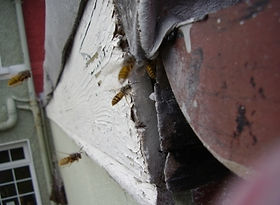
This image clearly illustrates a common entry point for a wasp nest: a structural crack leading directly into the void of a flat roof extension. The wasps are using this defect as a highway to their chosen nesting site, which is likely situated within a close proximity, generally less than a meter from the entry crack.
A flat roof or structure in poor repair, such as the one pictured, presents an open invitation to hibernating queen wasps in the early spring. They actively search for secure, sheltered, and readily accessible voids—perfect conditions offered by damaged roof spaces, fascia boards, or poorly sealed soffits. Once a queen establishes her nest, the colony will rapidly grow throughout the summer.
The most effective strategy for preventing wasps from nesting in your property is exclusion:
-
Proactive Proofing: Conduct regular inspections of your home's exterior, particularly roof lines, eaves, and window frames. Any visible crack, gap, or hole, even a small one, should be sealed using exterior sealant, mortar, or mesh appropriate for the material.
-
Remove the Invitation: By meticulously eliminating potential entry points, you remove the initial attraction for a searching queen. No Holes, No Wasps remains the simplest and most effective preventative pest control measure against these unwelcome summer tenants.
Dealing with a nest in a confined structural space like this is difficult and potentially dangerous; professional treatment is highly recommended to safely eliminate the colony and ensure the nest is completely sterilised.


All Videos
